Lockheed L-1649A Starliner, Version 2.0 Просмотр ZIP-архива
readme.txt
Lockheed L-1649A Starliner, Version 2.0
(27 October 2008)

Last and most illustrious in the series of Constellation designs, the
Starliner was designed to fly Los Angeles-London and Paris-Tokyo in 20-
plus hours non-stop. Providing accommodation for ninety-two tourist-
class or twenty-six first-class and forty-five tourist-class
passengers, the Starliner entered service with TWA in May 1957. Other
major operators included Air France and Lufthansa. Model, textures, and
VC by Manfred Jahn, panels and gauges by Hansjoerg Naegele, effects and
flight dynamics by Roland Berger, documentation by Howard Sodja.
Special features in version 2.0 include wing views, "inclined wheels"
nose-wheel steering, simplified reversing procedure, clickable
sunshades, backlit VC gauges, new flight dynamics, detailed reference
and checklist documents, period-style cockpit voices, and an early TWA
texture. Also included is the "squeaking brakes" effect created by
Diego S. Barreto. See the Starliner project threads at
calclassic.proboards55.com for repaints, questions and comments, and
general feedback.

INSTALLATION

FIRST-TIME USERS OF THE STARLINER PROCEED AS FOLLOWS

(1)	Extract the version 2.0 zip file to a temporary folder.

(2)	Copy the folder "Lockheed_L1649A" to your "Flight Simulator
9\Aircraft" folder.

(3)	Copy the *contents* of the folder "Effects" to your "Flight
Simulator 9\Effects" folder.

(4)	Copy the subfolders AddonVNCON30 and "squeaking brakes"
contained in the Sound folder to your "Flight Simulator
9\Sound" folder. (N.B. After copying, the FS9\Sound folder
should contain AddonVNCON30 and "squeaking brakes" as
subfolders.)

(5)	Copy the entire folder "squeaking brakes" contained in the
folder Gauges to your "Flight Simulator 9\Gauges" folder.
(After copying, the FS9\Gauges folder should contain "squeaking
brakes" as a subfolder.)

In the aircraft selection menu, the Starliner will show up under
Lockheed > L-1649A Starliner.


USERS UPDATING FROM PREVIOUS VERSIONS PROCEED AS FOLLOWS

(1)	Move your existing "Flight Simulator 9\Lockheed_L1649A" folder
to a backup location outside FS9, deleting the original folder.

(2)	Extract the version 2.0 zip to a separate temporary folder.

(3)	Proceed with steps (3)-(5) as detailed above for first-time
users, but overwriting when prompted.

(4)	If applicable, copy any previously downloaded sound and texture
folders from the backup folder created in step 1 to the new
target Lockheed_L1649A folder, overwriting the default
contents. Plus see note on Adding Older Repaints below.

(5)	If applicable, edit aircraft.cfg and/or panel.cfg to reflect
any changes you made to previous version files.


TESTING YOUR INSTALLATION

Start FS9 and select the new TWA Starliner. Use the default airport,
daylight conditions, and "fly now". Go to the VC cockpit and lower the
flaps one notch. You should hear the Captain say "Flaps 80" and the
First Officer confirm "Flaps coming 60". If you don't hear anything the
custom sound folder AddonVNCON30 isn't where it is supposed to be (see
above). Open the throttles a little until the aircraft begins to move
and then brake. You should hear a "squeaking brake" sound; if you don't
the *two* "squeaking brakes" folders aren't where they should be.

ADDING OLDER REPAINTS

Feel free to add older repaints, creating new texture folders and
updating the aircraft.cfg as necessary. Because the older paints are
likely to have few or no vc textures, use texture.N3707C as a source
folder and copy all files across to the added texture folder saying NO
when prompted to overwrite. A number of repaints are available at the
usual public domain servers as well as at Calclassic
calclassic.proboards55.com


DISCLAIMER: THE AUTHORS ARE NOT LIABLE FOR ANY DAMAGE THAT YOU MIGHT
INCUR AS A RESULT OF USING THESE FILES. YOU ASSUME THE RISK OF USE.


NOTES

In the present release, the sound defaults to the DC-3. Two more
appropriate sound packs are readily available from avsim and other
servers: Friedrich Trachsel's SCFA Breitling Connie sound and Diego S.
Barreto's 3350 soundpack.

Two port passenger exits can be opened on pressing Shift-E and Shift-E-
2, but there are no interior fittings.

Airstairs and wheel chocks appear when the following conditions are
met: aircraft on ground, rear passenger exit open, and parking brake
set.

Passenger and pilot wing views are invoked by pressing Ctrl-Shift-Num7,
Ctrl-Shift-Num9, Ctrl-Shift-Num1, or Ctrl-Shift-Num3.

Cowl-flaps open/close in increments on pressing Shift-Ctrl-V and Shift-
Ctrl-C respectively. Ten percent increment settings are available
through the cowl-flap simicon on the Captain's panel.

The check-mark simicon can be right-clicked to invoke a detailed status
window showing a number of current flight data settings some of which
are editable.

By default, the cockpit voices are audible in all view modes, including
external views (spot, tower). They can be muted, however, by flipping
the "MUTE" switch on the pilot's side panel.


OVERVIEW OF CHECKLIST AND REFERENCE MATERIAL
(by Howard Sodja)

For essential flying tips consult the reference and checklist sections
of the kneeboard (F10).  The checklist (L-1649A_check.htm) and
reference sheet spec (L-1649A_ref.htm) files are located in your local
Lockheed_L1649A folder.  As many users prefer to use a hard copy
checklist, I have included an MS Word checklist file (L-
1649A_check.doc), which is formatted for printing.

All of the checklist items and most of the reference sheet spec data
were taken from the official Trans World Airlines L-1649A Operating
Manual.  A hard copy of this manual can still be purchased at
www.esscoaircraft.com. Data from other sources are noted and referenced
where they are used.

I have attempted to duplicate the style and terminology used in this
TWA manual.  Because the L-1649A is the most complex piston-engine
airliner ever flown commercially, I was forced to significantly edit
and shorten the long TWA checklist down to the 9-page printed checklist
by only including checklist items for the primary controls and
instruments, and only the most important backup systems that are
modeled in our FS L-1649A.  A few important items have not yet been
modeled, or cannot be created because of FS limitations.   These items
are noted by an asterisk (*) in front of the checklist item.  I also
did not include the cabin environment items, as FS does not allow these
many additional controls, switches, meters, etc.

TAKEOFF, APPROACH & LANDING PROCEDURES
Be sure to review these procedures for various types of IFR and VFR
flights.  This section is followed by an EMERGENCY PROCEDURES section
for those who want to plan a challenging in-flight emergency.

SPECIFICATIONS and OPERATIONAL TABLES
The aircraft performance charts and tables that are assigned to each
aircraft have all of the engine and flight performance tables and
graphs for all flight conditions.  Unfortunately, no one seems to have
a copy of these detailed tables and graphs.  Therefore, the checklist
and reference sheet spec files only have engine and performance figures
that are in the TWA manual.  This data tends to be only for maximum
and/or  minimum weights, airspeeds, etc.  If a copy of these detailed
aircraft performance documents is obtained, the reference sheet will be
expanded to include this additional performance information that is
currently missing, such as V1 and V2 speeds at all gross weights.

The reference sheet begins with hardware and performance data that has
all the data you need for planning a realistic flight.  Our L-1649A
model will perform close to these figures.  In real aviation, aircraft
perform at factory specifications only when they leave the factory, so
in both FS and real life you never get the exact same performance that
is in the manuals.

PANEL & CONTROL FUNCTIONS
This last part of the reference sheet contains the thorough tutorial by
Tom Gibson that was in our first release.  As Tom and I have different
HTML editors that use slightly different HTML code, I had to reformat
some sections that my editor did not properly display.  Please let me
know if anything is displayed improperly.

I have been very busy working on our current release, and have not yet
had time to see if anything in Tom's tutorial needs to be altered to
conform with our latest model.  Please let me know if you find any such
discrepancies so they can be corrected.

Please send me any other errors that you may find in any of the above
documents. (Howard Sodja)


FSX USERS

Note that this is an FS9 native model that allows only restricted
operation in FSX. Specifically, there are some display problems in VC
mode, and the prop discs have to be replaced by more suitable ones. For
the latter issue we have included a folder called FSX_Propdisks, which
offers a choice of discs. See the readme file contained in that folder
for installation instructions.

COPYRIGHT

Redistributing this archive with any files added, removed or modified
is prohibited.

This archive (or any parts of it) may NOT be included in other packages
without the written permission of the authors.

No specific charge may be made for this archive and it may not be
uploaded to any server that specifies that the server owners hold a
copyright (of any sort) on this archive when stored on that server. You
may NOT use the archive (or any parts of it) for commercial purpose
without all the authors' explicit, written permission in advance. This
includes "free" CD or DVD compilations with a charge of any kind.


CREDITS

Effects by Milton Shupe (engine), Hansjoerg Naegele (fueldump), Wayne
Tudor (exhaust flames), and Diego S. Barreto (squeaking brakes and FSX
prop discs). Effects rework by Roland Berger and Hansjoerg Naegele.

The cockpit voice files were created by Howard Sodja (pilot) and Tom
Gibson (First Officer).

Panel and gauges: Original main panel bitmap by Jan Visser. Main panel
bitmap rework by Hansjoerg Naegele and Steve Hornberger. Parts of the
main panel bitmap are based on John Dow's cockpit pictures
(cpjpeg99.zip) of the HARS Connie (VH-EAG). The overhead/windows
section and the throttle levers of the main panel bitmap contain
bitmaps made by Louis Betti. The FE panel bitmap was made by Hansjoerg
Naegele using a photo of the MATS Connie taken from Graham Robson's
book Prop Perfection - Restored Propliners and Warbirds, 1997
Motorbooks International. Further bitmaps are based on photos provided
by Bill Rambow, Jan Visser, Tim Hanna, Howard Sodja, John Howard White,
Dai Griffiths, and Bill Smith. Gauge bitmaps and programming: Hansjoerg
Naegele. The VORLOC indicator is a copy of the T37_VOR1 from HGHB
Virtual Instruments (Harald Geier, Helmut Busch, Christian Koegler,
Tony Cullen) and contains bitmaps taken from the original gauge. Other
bitmaps, sound and effects files are modified versions originally taken
from Flight Simulator 2002, 2004, and FSX.

We are particularly grateful for suggestions, advice, and materials
offered by the members of Calclassic - FSAviator, Tom Gibson, Dave
McQueen, Milton Shupe, Russ Tucker, Jean Maridor, Alejandro_SD, Volker
Boehme, Maarten Brouwer, Diego S. Barreto, Randy Cain, Wolfgang, Pao,
riogrande, t.creed, Colonial, RadioRangeR, and many others.


SOURCES

Anderson, Holmes G. Profile Publications 120: The Lockheed
Constellation. Windsor, 1967.

Breffort, Dominique: Lockheed Constellation: From Excalibur to
Starliner. Paris: Histoire & Collections 2006 ISBN 2-915239-62-2

Flight Operation Handbook. Lockheed Super Constellation. Lockheed
Report 8758.

FAA Type Certificate Data Sheet  L-1649A (TCDS  4A17).

Green, William; Punnett, Dennis I. The Macdonald Aircraft Handbook.
London: Macdonald, 1964.

Henderson, Scott: Constellation in Color . Porteland,
Newcastle-Upon-Tyne: Scoval, 2005 ISBN 1 902236 12 2

Jane's All the World's Aircraft (various editions).

Lockheed Aircraft Corporation. Model 1649 Maintenance Manual: General
Dimensions. Burbank, 1957.

Marson, Peter J. The Lockheed Constellation Series. Air Britain:
London, 1982.

Marson, Peter J. The Lockheed Constellation. Tonbridge: Air
Britain, 2007. ISBN 0 85130 366 8 9780851 303666

Morgan, Terry. The Lockheed Constellation. New York: Arco, 1967.

Springfellow, Curtiss K., Peter M. Bowers. Lockheed Constellation MBI
Publishing 1992. ISBN 0.87938-379-8

Taylor, H.A. Air Enthusiast No. 14: Constellation: Lockheed's "Queen of
the Skies". Ducimus Books: London, 1980.

TWA L-1649A Operating Manual. Transportation Training Dept. Kansas
City, 1960-61.

Wilson, Stewart: Lockheed Constellation. Aviation Notebook
Series. Bungendore: Notebook Pub., 2001. ISBN 1 876722 03 7

Wings of Fame, Volume 20. Heathcott, John, Ed. USA: Westport: Aerospace
Publishing, 2000 UK: London: Airtime Publishing , 2000. Pages 112-139.

Woods, John and Maureen. Constellation Production List. Airline
Publications: Hounslow, 1980.


27 October 2008

Manfred [dot] Jahn [at] uni-koeln [dot] de
16292_l1649a_version_2.0.zip
| Имя файла | Дата | Размер |
|---|---|---|
| Effects/ | 26.10.2008 22:38 | |
| Effects/fx_1649A_contrail.fx | 19.04.2008 17:53 | 2 KB |
| Effects/fx_1649A_engstrt.fx | 21.04.2008 16:40 | 8 KB |
| Effects/fx_1649A_exh.fx | 21.04.2008 14:46 | 4 KB |
| Effects/fx_1649A_fueldump.fx | 19.04.2008 17:55 | 4 KB |
| Effects/fx_1649A_landing.fx | 16.04.2008 00:12 | 3 KB |
| Effects/texture/ | 26.10.2008 22:38 | |
| Effects/texture/fx_1649A_flamea.bmp | 30.07.2004 17:44 | 5 KB |
| Effects/texture/fx_1649A_flameb.bmp | 21.04.2008 02:59 | 6 KB |
| Gauges/ | 26.10.2008 22:40 | |
| Gauges/squeaking brakes/ | 26.10.2008 22:40 | |
| Gauges/squeaking brakes/BrakeSound.xml | 21.05.2008 21:08 | 440 B |
| Gauges/squeaking brakes/Thumbs.db | 19.05.2008 01:35 | 20 KB |
| Lockheed_L1649A/ | 28.10.2008 00:42 | |
| Lockheed_L1649A/aircraft.cfg | 28.10.2008 00:25 | 16 KB |
| Lockheed_L1649A/FSX_Propdisks/ | 27.10.2008 17:46 | |
| Lockheed_L1649A/FSX_Propdisks/0readme_propdisks.txt | 27.10.2008 17:52 | 998 B |
| Lockheed_L1649A/FSX_Propdisks/propdisk_grey.bmp | 02.06.2008 04:21 | 341 KB |
| Lockheed_L1649A/FSX_Propdisks/propdisk_grey.dds | 23.10.2008 15:02 | 341 KB |
| Lockheed_L1649A/FSX_Propdisks/propdisk_redblue.bmp | 23.10.2008 14:58 | 341 KB |
| Lockheed_L1649A/FSX_Propdisks/propdisk_redblue.dds | 23.10.2008 15:02 | 341 KB |
| Lockheed_L1649A/FSX_Propdisks/propdisk_redbluedark.bmp | 09.09.2008 13:29 | 256 KB |
| Lockheed_L1649A/FSX_Propdisks/propdisk_redbluedark.dds | 22.10.2008 19:47 | 256 KB |
| Lockheed_L1649A/L-1649A_check.doc | 27.10.2008 11:23 | 144 KB |
| Lockheed_L1649A/L-1649A_check.htm | 27.10.2008 11:40 | 104 KB |
| Lockheed_L1649A/L-1649A_images/ | 28.10.2008 00:09 | |
| Lockheed_L1649A/L-1649A_images/clear tab.gif | 05.04.2008 14:27 | 51 B |
| Lockheed_L1649A/L-1649A_images/clear-vert.gif | 20.06.2007 15:18 | 48 B |
| Lockheed_L1649A/L-1649A_images/clear.gif | 05.04.2008 14:27 | 846 B |
| Lockheed_L1649A/L-1649A_images/Density_Alt_chart.gif | 20.12.2007 15:39 | 68 KB |
| Lockheed_L1649A/L-1649A_images/L-1649FuelUse.jpg | 23.06.2008 15:23 | 121 KB |
| Lockheed_L1649A/L-1649A_images/Thumbs.db | 26.10.2008 18:34 | 22 KB |
| Lockheed_L1649A/L-1649A_images/Tutorial_images/ | 28.10.2008 00:09 | |
| Lockheed_L1649A/L-1649A_images/Tutorial_images/aux_control1649A.jpg | 13.04.2008 19:54 | 5 KB |
| Lockheed_L1649A/L-1649A_images/Tutorial_images/bg.gif | 26.01.2004 07:32 | 11 KB |
| Lockheed_L1649A/L-1649A_images/Tutorial_images/clear tab.gif | 05.04.2008 14:27 | 51 B |
| Lockheed_L1649A/L-1649A_images/Tutorial_images/clear.gif | 05.04.2008 14:27 | 846 B |
| Lockheed_L1649A/L-1649A_images/Tutorial_images/dots.gif | 17.04.2003 16:22 | 40 B |
| Lockheed_L1649A/L-1649A_images/Tutorial_images/EAS-TAS.gif | 04.07.2008 12:30 | 3 KB |
| Lockheed_L1649A/L-1649A_images/Tutorial_images/EASgraph.jpg | 04.07.2008 12:49 | 103 KB |
| Lockheed_L1649A/L-1649A_images/Tutorial_images/fepan1049G.jpg | 06.03.2006 22:18 | 32 KB |
| Lockheed_L1649A/L-1649A_images/Tutorial_images/fuel_system1649A-large.jpg | 14.04.2008 00:48 | 114 KB |
| Lockheed_L1649A/L-1649A_images/Tutorial_images/fuel_system1649A.jpg | 29.06.2008 01:48 | 103 KB |
| Lockheed_L1649A/L-1649A_images/Tutorial_images/glareshield_radio1049G.jpg | 22.01.2006 01:05 | 1 KB |
| Lockheed_L1649A/L-1649A_images/Tutorial_images/L-1649Fueling.jpg | 28.06.2008 15:37 | 77 KB |
| Lockheed_L1649A/L-1649A_images/Tutorial_images/lower_fepan1049G.jpg | 22.01.2006 00:15 | 4 KB |
| Lockheed_L1649A/L-1649A_images/Tutorial_images/mainpan1649A.jpg | 16.05.2008 01:51 | 31 KB |
| Lockheed_L1649A/L-1649A_images/Tutorial_images/overhead_fuel.jpg | 22.01.2006 00:22 | 4 KB |
| Lockheed_L1649A/L-1649A_images/Tutorial_images/StartingEngine_3-large.jpg | 18.04.2008 20:14 | 56 KB |
| Lockheed_L1649A/L-1649A_images/Tutorial_images/StartingEngine_3.jpg | 29.06.2008 11:55 | 121 KB |
| Lockheed_L1649A/L-1649A_images/Tutorial_images/Thumbs.db | 26.10.2008 18:37 | 70 KB |
| Lockheed_L1649A/L-1649A_images/Tutorial_images/upper_fepan1649A.jpg | 13.04.2008 19:42 | 4 KB |
| Lockheed_L1649A/L-1649A_ref.htm | 22.10.2008 10:41 | 231 KB |
| Lockheed_L1649A/L1649A.air | 21.10.2008 15:00 | 9 KB |
| Lockheed_L1649A/model/ | 27.10.2008 18:55 | |
| Lockheed_L1649A/model/1649vc20.mdl | 28.10.2008 01:00 | 3 MB |
| Lockheed_L1649A/model/model.cfg | 08.08.2008 20:50 | 29 B |
| Lockheed_L1649A/panel/ | 27.10.2008 12:21 | |
| Lockheed_L1649A/panel/ControlStand1649A_Popup.bmp | 16.03.2008 22:51 | 115 KB |
| Lockheed_L1649A/panel/FD_Test/ | 26.10.2008 22:17 | |
| Lockheed_L1649A/panel/FD_Test/FD_Test.txt | 19.10.2008 21:34 | 2 KB |
| Lockheed_L1649A/panel/FD_Test/Ground.xml | 07.01.2008 23:54 | 2 KB |
| Lockheed_L1649A/panel/FD_Test/GroundRoll.xml | 19.10.2008 22:15 | 8 KB |
| Lockheed_L1649A/panel/FD_Test/GroundRoll_Airspeed.bmp | 01.10.2008 20:13 | 3 KB |
| Lockheed_L1649A/panel/FD_Test/GroundRoll_BG.bmp | 01.10.2008 14:47 | 11 KB |
| Lockheed_L1649A/panel/FD_Test/GroundRoll_Landing.bmp | 19.10.2008 19:13 | 3 KB |
| Lockheed_L1649A/panel/FD_Test/GroundRoll_Liftoff.bmp | 01.10.2008 20:14 | 3 KB |
| Lockheed_L1649A/panel/FD_Test/GroundRoll_Obstacle.bmp | 01.10.2008 14:48 | 3 KB |
| Lockheed_L1649A/panel/FD_Test/GroundRoll_Touchdown.bmp | 01.10.2008 14:49 | 3 KB |
| Lockheed_L1649A/panel/FD_Test/Ground_BG.bmp | 04.01.2008 23:26 | 11 KB |
| Lockheed_L1649A/panel/FD_Test/Ground_Liftoff.bmp | 04.01.2008 22:30 | 3 KB |
| Lockheed_L1649A/panel/FD_Test/Ground_Touchdown.bmp | 04.01.2008 22:31 | 3 KB |
| Lockheed_L1649A/panel/FD_Test/Pitch.xml | 14.10.2008 23:06 | 8 KB |
| Lockheed_L1649A/panel/FD_Test/Pitch_BG.bmp | 09.01.2008 17:58 | 67 KB |
| Lockheed_L1649A/panel/FD_Test/Pitch_Bug1.bmp | 04.01.2008 21:33 | 1 KB |
| Lockheed_L1649A/panel/FD_Test/Pitch_Bug2.bmp | 04.01.2008 21:33 | 1 KB |
| Lockheed_L1649A/panel/FD_Test/Pitch_Knob1.bmp | 04.01.2008 21:34 | 3 KB |
| Lockheed_L1649A/panel/FD_Test/Pitch_Knob2.bmp | 04.01.2008 21:34 | 3 KB |
| Lockheed_L1649A/panel/FD_Test/Pitch_Needle1.bmp | 04.01.2008 21:32 | 2 KB |
| Lockheed_L1649A/panel/FD_Test/Pitch_Needle2.bmp | 04.01.2008 21:32 | 2 KB |
| Lockheed_L1649A/panel/FD_Test/Slats.xml | 19.02.2008 18:40 | 4 KB |
| Lockheed_L1649A/panel/FD_Test/Slats_BG.bmp | 09.01.2008 17:48 | 53 KB |
| Lockheed_L1649A/panel/FD_Test/Slats_Needle1.bmp | 04.01.2008 21:32 | 2 KB |
| Lockheed_L1649A/panel/FD_Test/Slats_Needle2.bmp | 04.01.2008 21:32 | 2 KB |
| Lockheed_L1649A/panel/Fepanel30.bmp | 20.09.2006 21:32 | 2 MB |
| Lockheed_L1649A/panel/FuelControls_Popup.bmp | 17.02.2006 18:17 | 88 KB |
| Lockheed_L1649A/panel/LowerFE_Popup.bmp | 20.10.2005 19:30 | 159 KB |
| Lockheed_L1649A/panel/Mainpanel30_1049.bmp | 20.09.2006 21:48 | 2 MB |
| Lockheed_L1649A/panel/panel.cfg | 28.10.2008 00:56 | 13 KB |
| Lockheed_L1649A/panel/UpperFE1649A_Popup.bmp | 14.03.2008 21:05 | 100 KB |
| Lockheed_L1649A/panel/Views2D.CAB | 28.08.2008 23:19 | 3 KB |
| Lockheed_L1649A/panel/VNCon30.gau | 11.10.2008 21:34 | 56 KB |
| Lockheed_L1649A/panel/VNConnie1649A.CAB | 27.10.2008 00:55 | 2 MB |
| Lockheed_L1649A/panel/Yoke.bmp | 17.02.2006 18:40 | 129 KB |
| Lockheed_L1649A/readme.doc | 28.10.2008 00:41 | 62 KB |
| Lockheed_L1649A/readme.txt | 28.10.2008 00:42 | 13 KB |
| Lockheed_L1649A/Sound/ | 26.10.2008 22:18 | |
| Lockheed_L1649A/Sound/sound.cfg | 21.04.2008 00:26 | 33 B |
| Lockheed_L1649A/texture.N7307C/ | 26.10.2008 22:18 | |
| Lockheed_L1649A/texture.N7307C/floor_2.bmp | 08.10.2008 18:41 | 65 KB |
| Lockheed_L1649A/texture.N7307C/fuse_l.bmp | 21.05.2008 19:43 | 1 MB |
| Lockheed_L1649A/texture.N7307C/fuse_t.bmp | 14.10.2008 23:48 | 1 MB |
| Lockheed_L1649A/texture.N7307C/propdisk.bmp | 26.10.2008 19:56 | 256 KB |
| Lockheed_L1649A/texture.N7307C/shade_01.bmp | 14.08.2008 12:38 | 64 KB |
| Lockheed_L1649A/texture.N7307C/vc01.bmp | 27.10.2008 23:18 | 1 MB |
| Lockheed_L1649A/texture.N7307C/vc01a_l.bmp | 26.10.2008 20:16 | 64 KB |
| Lockheed_L1649A/texture.N7307C/vc01_l.bmp | 24.10.2008 14:04 | 64 KB |
| Lockheed_L1649A/texture.N7307C/vc02.bmp | 25.10.2008 00:27 | 1 MB |
| Lockheed_L1649A/texture.N7307C/vc02_l.bmp | 25.10.2008 00:28 | 64 KB |
| Lockheed_L1649A/texture.N7307C/vc03.bmp | 21.10.2008 19:22 | 1 MB |
| Lockheed_L1649A/texture.N7307C/vc03_l.bmp | 23.10.2008 21:39 | 64 KB |
| Lockheed_L1649A/texture.N7307C/vc04.bmp | 27.10.2008 19:11 | 1 MB |
| Lockheed_L1649A/texture.N7307C/vc04_l.bmp | 24.10.2008 19:06 | 64 KB |
| Lockheed_L1649A/texture.N7307C/vc05.bmp | 23.10.2008 19:45 | 1 MB |
| Lockheed_L1649A/texture.N7307C/vc05_l.bmp | 24.10.2008 13:31 | 64 KB |
| Lockheed_L1649A/texture.N7307C/vc06.bmp | 23.10.2008 21:40 | 1 MB |
| Lockheed_L1649A/texture.N7307C/vc06_l.bmp | 24.10.2008 13:31 | 64 KB |
| Lockheed_L1649A/texture.N7307C/wings2_l.bmp | 21.03.2007 01:00 | 1 KB |
| Lockheed_L1649A/texture.N7307C/wings2_t.bmp | 13.10.2008 14:02 | 1 MB |
| Lockheed_L1649A/texture.N7307C/wings_l.bmp | 21.03.2007 01:00 | 1 KB |
| Lockheed_L1649A/texture.N7307C/wings_t.bmp | 13.10.2008 14:02 | 1 MB |
| Lockheed_L1649A/texture.N7307C/xx1cal.bmp | 15.10.2008 00:22 | 16 KB |
| Lockheed_L1649A/texture.N7307C/xxcal_121.bmp | 02.12.2007 19:00 | 8 KB |
| Sound/ | 26.10.2008 22:39 | |
| Sound/AddonVNCON30/ | 28.10.2008 00:14 | |
| Sound/AddonVNCON30/button.wav | 01.01.2006 21:26 | 6 KB |
| Sound/AddonVNCON30/cabin.wav | 21.09.2008 21:57 | 47 KB |
| Sound/AddonVNCON30/call_flaps_80.wav | 11.10.2008 16:38 | 144 KB |
| Sound/AddonVNCON30/call_flaps_down.wav | 11.10.2008 16:38 | 158 KB |
| Sound/AddonVNCON30/call_flaps_up.wav | 11.10.2008 16:38 | 124 KB |
| Sound/AddonVNCON30/call_gear_down.wav | 11.10.2008 16:38 | 125 KB |
| Sound/AddonVNCON30/call_gear_up.wav | 11.10.2008 16:38 | 120 KB |
| Sound/AddonVNCON30/call_start1.wav | 02.10.2008 17:57 | 34 KB |
| Sound/AddonVNCON30/call_start2.wav | 02.10.2008 17:56 | 47 KB |
| Sound/AddonVNCON30/call_start3.wav | 02.10.2008 17:53 | 42 KB |
| Sound/AddonVNCON30/call_start4.wav | 02.10.2008 17:55 | 43 KB |
| Sound/AddonVNCON30/call_TO_power.wav | 02.10.2008 18:01 | 42 KB |
| Sound/AddonVNCON30/click.wav | 18.08.2005 23:14 | 3 KB |
| Sound/AddonVNCON30/knob.wav | 01.01.2006 21:26 | 9 KB |
| Sound/AddonVNCON30/latch.wav | 30.06.2001 03:08 | 3 KB |
| Sound/AddonVNCON30/lever.wav | 08.06.2008 18:50 | 7 KB |
| Sound/AddonVNCON30/round_button.wav | 15.08.2001 22:57 | 2 KB |
| Sound/AddonVNCON30/round_switch.wav | 01.01.2006 20:51 | 5 KB |
| Sound/AddonVNCON30/round_switch_off.wav | 01.01.2006 20:51 | 4 KB |
| Sound/AddonVNCON30/springloaded.wav | 14.11.2005 22:42 | 3 KB |
| Sound/AddonVNCON30/toggle_switch.wav | 15.08.2001 22:57 | 3 KB |
| Sound/AddonVNCON30/voice_v1.wav | 16.10.2008 02:45 | 108 KB |
| Sound/AddonVNCON30/voice_v2.wav | 16.10.2008 02:45 | 129 KB |
| Sound/squeaking brakes/ | 26.10.2008 22:39 | |
| Sound/squeaking brakes/SB01_Brakes.wav | 19.05.2008 11:14 | 656 KB |
| Sound/squeaking brakes/Sound.ini | 20.05.2008 12:05 | 157 B |
| readme.txt | 28.10.2008 00:42 | 13 KB |
| avsim_su.diz | 05.11.2008 02:07 | 406 B |
| Итого: | 26 MB | |
Lockheed L-1649A Starliner, Version 2.0
| Rating: 4.8!
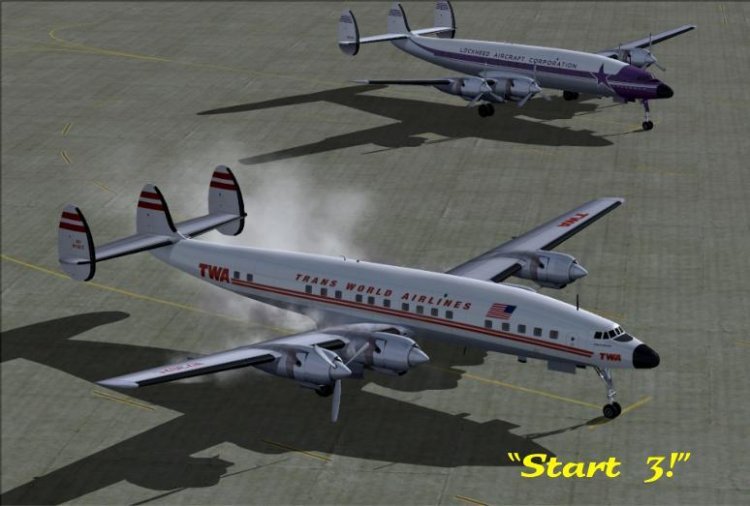
Last and most illustrious in the series of Constellation designs, the Starliner was designed to fly Los Angeles-London and Paris-Tokyo in 20- plus hours non-stop. Providing accommodation for ninety-two tourist- class or twenty-six first-class and forty-five tourist-class passengers, the Starliner entered service with TWA in May 1957. Other major operators included Air France and Lufthansa. Model, textures, and VC by Manfred Jahn, panels and gauges by Hansjoerg Naegele, effects and flight dynamics by Roland Berger, documentation by Howard Sodja. Special features in version 2.0 include wing views, "inclined wheels" nose-wheel steering, simplified reversing procedure, clickable sunshades, backlit VC gauges, new flight dynamics, detailed reference and checklist documents, period-style cockpit voices, and an early TWA texture. Also included is the "squeaking brakes" effect created by Diego S. Barreto. See the Starliner project threads at calclassic.proboards55.com for repaints, questions and comments, and general feedback.
→ Size:
11 MB
→ Date:
17 years ago (05.11.2008 13:40)
→ Approved by moderator:
seric76
→ License:
Freeware - Free version, Unlimited Distribution
→ Downloaded:
4640 time(s)